
Sound: 


Value:
(Read about our ratings)
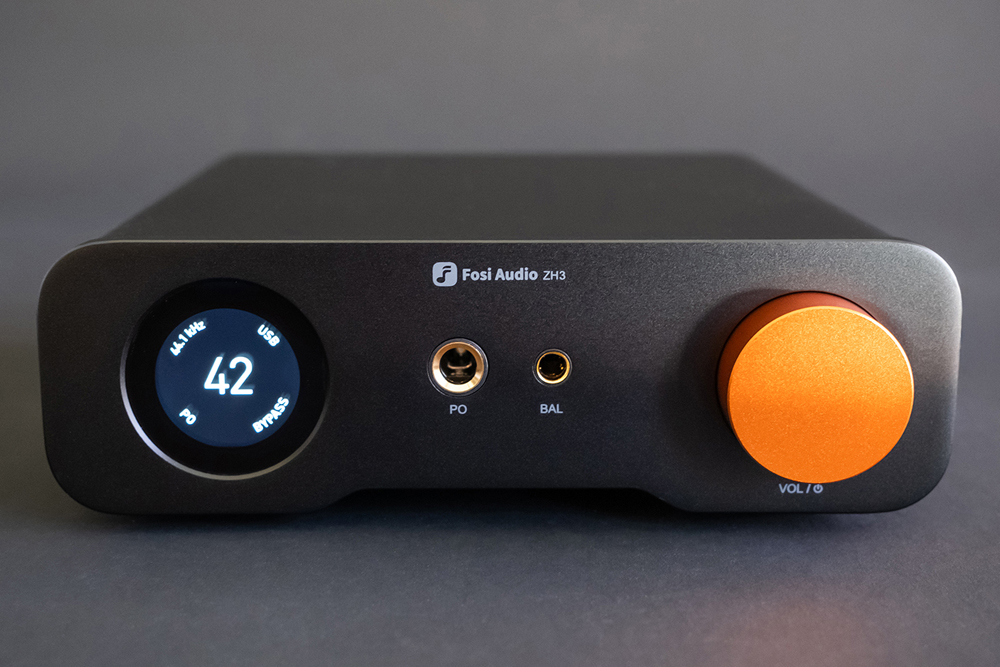
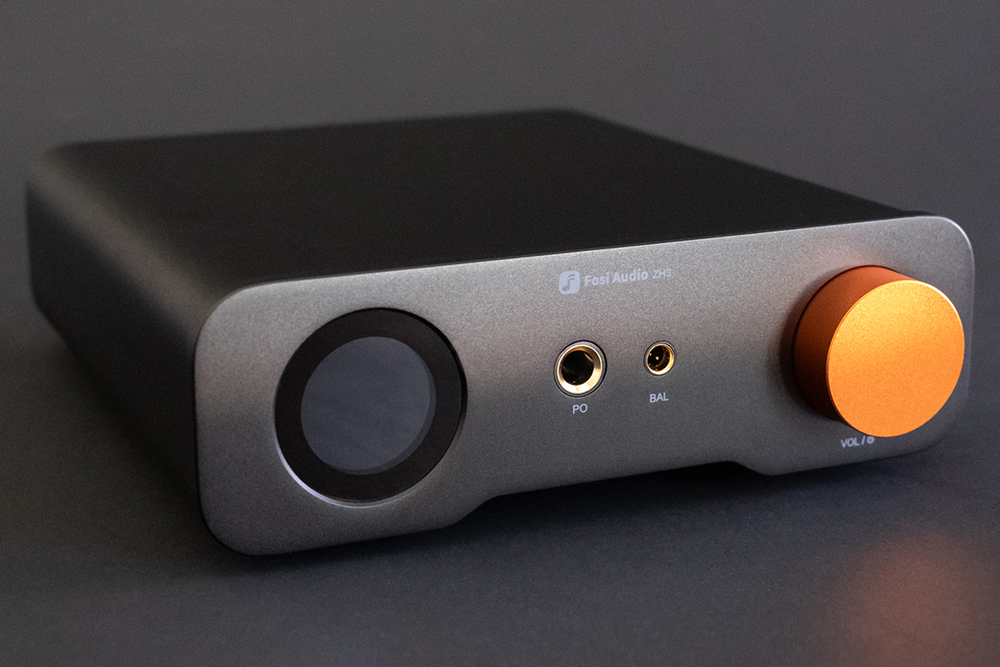
 When Fosi sent me the big i5 planar-magnetic headphones, I also received the company’s small ZH3 DAC/Amp. Well, it’s reasonably small. It’s larger than the diminutive Schiit Audio Magni, but smaller than something like the HiFiMan EF400. Inside are an AKM AK4493SEQ DAC and four TI OPA1612 amps. A brassy-orange volume knob doubles as a control for radial menus on a small, round screen. Overall, it looks somewhat minimalist, but the ZH3 has lots of useful features and big sound for just US$199.99, CA$274, £148, €169.95, as of this writing in mid-February.
In the box
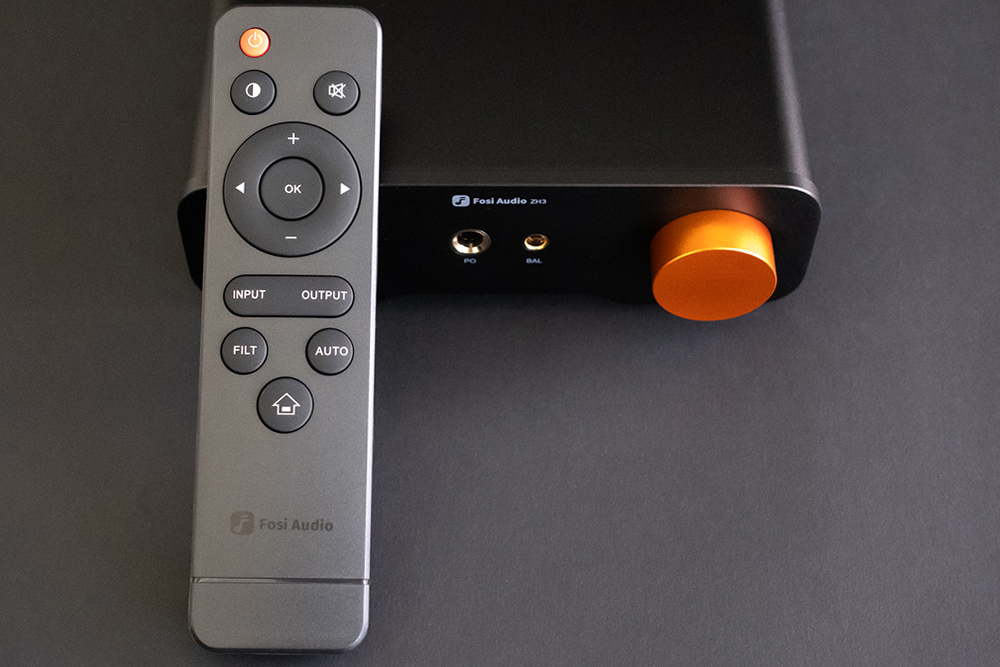
With the ZH3 you get a 3.5-to-6.35mm adapter, a 12V trigger cable, a USB‑A-to-USB‑C cable, and most useful, a small remote. Like most desktop headphone amps, it’s powered by a separate power brick, also included.
Use
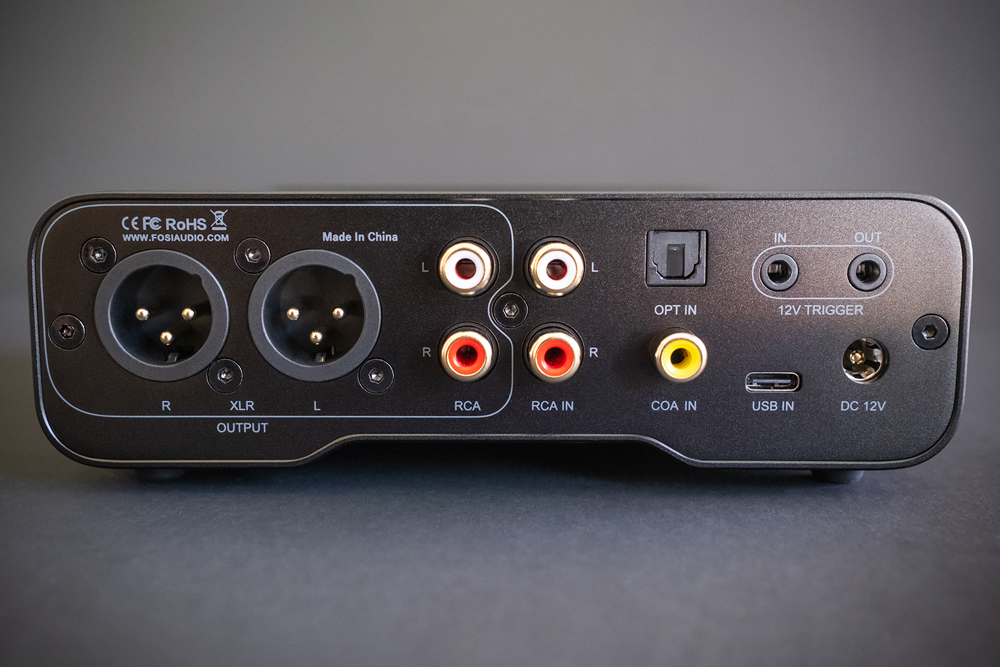
I connected the ZH3 to my PC using USB‑C, but that’s not the only way to connect a source. On the back are also optical (TosLink) and coaxial (RCA) S/PDIF inputs, most likely for use with a CD or other disc player. You can also go analog via RCA inputs. To get that sound back out again, the front has unbalanced 6.35mm (¼″) and balanced 4.4mm connections. Fosi claims these output 640mW at 32 ohms and 2570mW at 32 ohms, respectively. On the back there are RCA and XLR outputs for connection to powered speakers or other gear.
Speaking of other gear, the ZH3 shares its overall design with two other Fosi products, the ZD3, which is a standalone DAC that uses ESS chips instead of AKM, and the ZA3, an amp rated at 180Wpc into 4 ohms. I don’t think most people would need a separate DAC for a small audio system, but the ZD3 has an HDMI input, whereas the ZH3 doesn’t.
The ZH3’s volume knob is also a button. Holding it down turns the unit off, but pressing it brings up the ZH3’s settings menu. Here you rotate and press to select different items. This works pretty well, though navigating with the remote is a little faster. You can select different filters, adjust treble and bass (there’s a bypass option to skip this circuit), and adjust the gain to help match your specific headphones.
Sound
To test the ZH3, I used Fosi’s i5 as well as the HiFiMan Isvarna headphones. Both are big planar-magnetic designs. There are harder-to-drive ’phones out there, but these are good examples of headphones that are best used with an amp without being real edge-case, ultra-difficult headphones that most people will likely never own.
The ZH3 drove the Isvarnas cleanly up to and including the max volume. They were able to maintain the intense bass of “Derezzed (Remixed by The Glitch Mob)” from TRON: Legacy Reconfigured (16‑bit/44.1kHz ALAC, Walt Disney Records / Apple Music), even at unsafe volume levels. Even with the insanely low bass of Daniel Lanois’s “Power of One” (Rockets, 16/44.1 ALAC, Daniel Lanois / Apple Music), the ZH3 kept the Isvarnas controlled.
Switching to the i5s, Röyksopp’s “Impossible (True Electric)” (True Electric, 16/44.1 ALAC, Dog Triumph / Apple Music) was a similar story. The ZH3 controlled the big planar drivers well, with fast transients and strong bass.
With the Dave Brubeck Quartet’s “Blue Rondo à la Turk” (Time Out, 24/48 ALAC, Columbia / Apple Music), the ZH3 was able to produce clean, smooth highs. Personally, I’m not interested in filters, and cycling through the options here, I didn’t find any that seemed more interesting than Bypass. There are five other options to play around with if you’re inclined.
Comparison
The Schiit Audio Magni has long been my reference for affordable DAC–headphone amps. Playing the TRON: Legacy and Daniel Lanois tracks through the HiFiMan planars, the Magni was able to deliver similar volume to the ZH3 when both were set to their high-gain modes, but the Magni wasn’t quite as clean running full throttle.
With Röyksopp’s “Impossible (True Electric)” and Fosi’s i5 headphones, the Magni sounded clean up to around 80 to 85 percent maximum volume, above which the combo started sounding a bit harsh. With the ZH3, this point was above 90 percent, and the ZH3 sounded cleaner at maximum volume. The difference wasn’t huge, however. Both amps sounded equally smooth and clean on the Brubeck track.
Conclusion
As mentioned, the Schiit Audio Magni is my baseline for budget headphone amps. It works great, and the price is right. For most people, the Magni will have plenty of power for just about every headphone. So where does the ZH3 sit in comparison? They’re basically the same price, but the Fosi looks higher-end. The orange/copper volume knob, screen, and actual menus all make it seem more expensive. The additional inputs and outputs also make it more useful.
The Magni’s best attributes are size and simplicity. Want to boost the gain? Flip a switch on the front. Change inputs? Again, just a switch. That might not be enough for some people, though, as it lacks balanced outputs and a remote, and you can’t connect a disc player or other digital source.
Since sound-wise they’re both going to power your headphones to exceedingly high levels, it comes down to whether you want a smaller size or looks and features. There are no bad choices between these two.
. . . Geoffrey Morrison
Associated Equipment
- PC: iBuyPower Windows 11
- DAC-headphone amplifier: Schiit Audio Magni, HiFiMan EF400
- Headphones: Fosi Audio i5, HiFiMan Isvarna
Fosi Audio ZH3 DAC-headphone amplifier
Price: US$199.99, CA$274, £148, €169.95
Warranty: 24 months
Fosi Audio
Aohua Building
Dalang Street, Longhua District
Shenzhen, 518116
Guangdong, China
Phone: +861-371-661-2254
Email:
Website: www.fosiaudio.com