
Sound: 


Value:
(Read about our ratings)
Perhaps by accident, I’ve become a bit of a cheerleader for Ferrum Audio. This isn’t a case of journalistic bias; the Warsaw, Poland–based company habitually puts out superlative products. I reviewed the Wandla DAC and Hypsos power supply a couple of years ago for SoundStage! Hi‑Fi and found that the combo’s fit and finish, subjective performance, and objective measurements placed it among the best out there. The Erco Gen 2 DAC–headphone amp (US$2050, CA$2890, £1795, €1795) isn’t a new product per se, but there’s been little press since the original Erco was updated to this “Gen 2” spec. Naturally, I had to find out firsthand how this second generation improves upon the first—and whether Ferrum’s DAC-amp combo device follows in the footsteps of the Wandla.
Rig rundown
There have been several updates and iterations of Ferrum’s lineup since I reviewed the Wandla and Hypsos back in 2024, so before I dive into the Erco Gen 2, here’s a brief overview of the current Ferrum products.
The Oor (US$2275, CA$3190, £1995, €1995) is Ferrum’s flagship headphone amplifier. A fully balanced headphone amp with analog inputs and a four-pin-XLR balanced headphone output, the Oor utilizes discrete circuitry with the aim of minimizing nonlinearities across the audioband.
The Wandla (US$3195, CA$4290, £2795, €2795) is Ferrum’s flagship DAC. My review has the lowdown on its tech, so I won’t reiterate it here. Ferrum has since released the GoldenSound Edition of the Wandla, which adds features called Spatial Enhancement, Impact+, and Tube Mode via onboard DSP. The Wandla GoldenSound Edition Gen 2 goes for US$3695, CA$4495, £3395, or €3295, though existing Wandlas may be upgraded to the GoldenSound spec for US$595 or €595. And the Wandla HP, which adds a capable headphone output to the base Wandla, can be had for the same price as the GoldenSound Edition.
What is the Erco, then? First things first, it’s pronounced like “Air-tso,” not “Ur-ko.” The Erco Gen 2 straddles the line between the Wandla and the Oor. It takes inspiration from both but encroaches on neither, combining digital conversion and headphone-level amplification into a single device. The Erco Gen 2 represents Ferrum’s “value” option, though I say that with some hesitancy—there haven’t really been any corners cut; rather, the Erco Gen 2 fulfils a different set of needs than either of its stablemates.
All these devices are compatible with Ferrum’s Hypsos hybrid power supply. I covered the Hypsos in my previous review, so you’ll find an overview there. The Hypsos currently sells for US$1395, CA$1790, £1095, or €1195, and the Hypsos Dual Output will run you US$1595, CA$1990, £1395, or €1395.
Outside overview
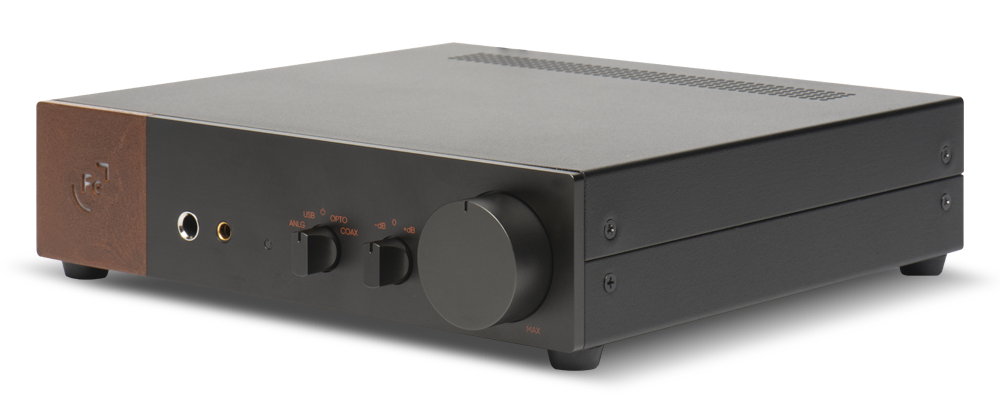
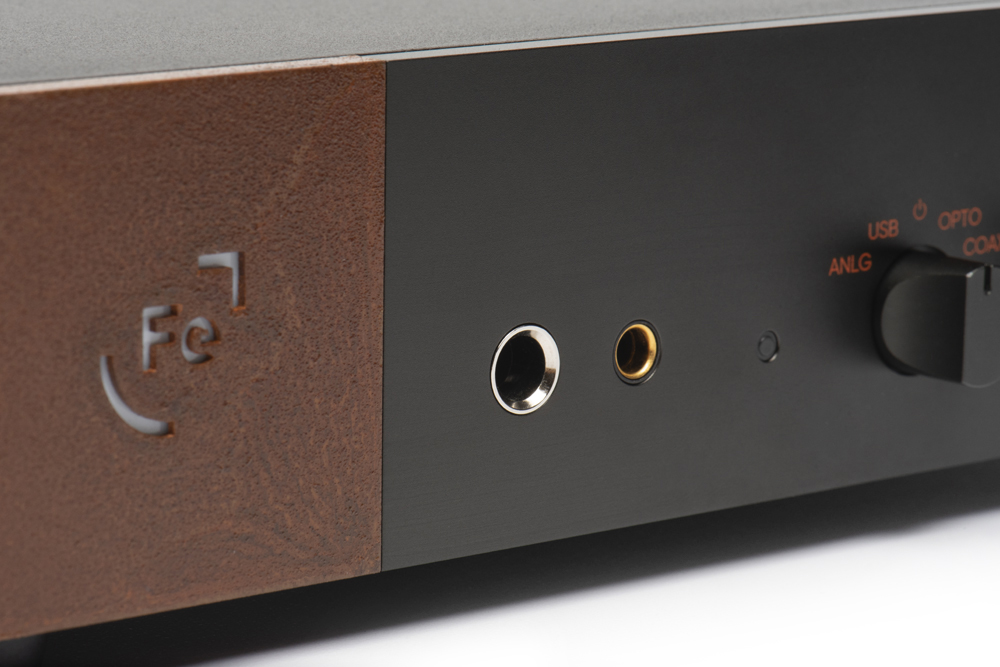
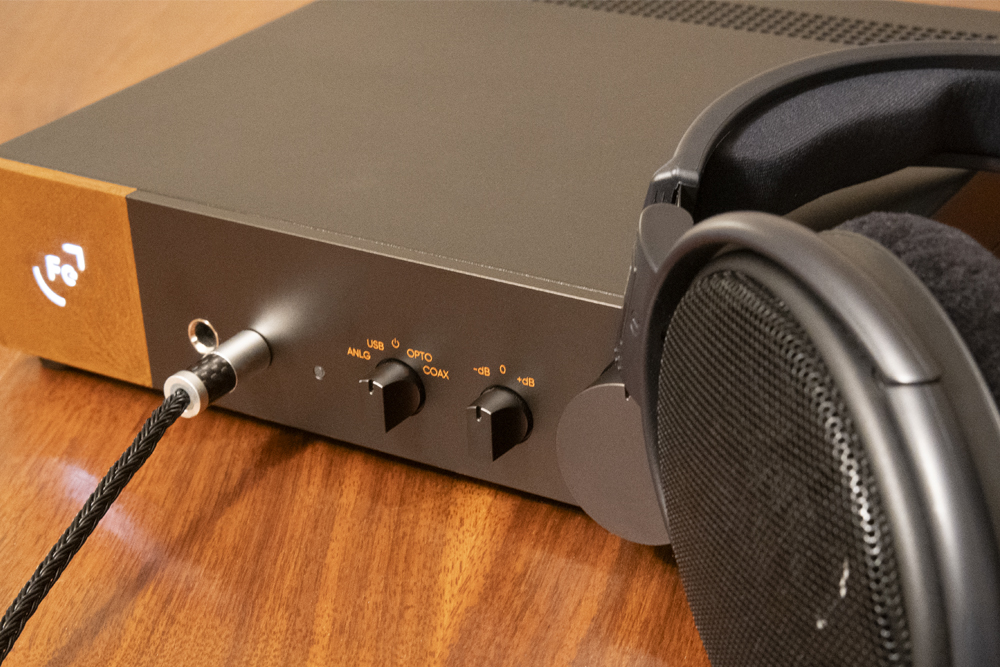
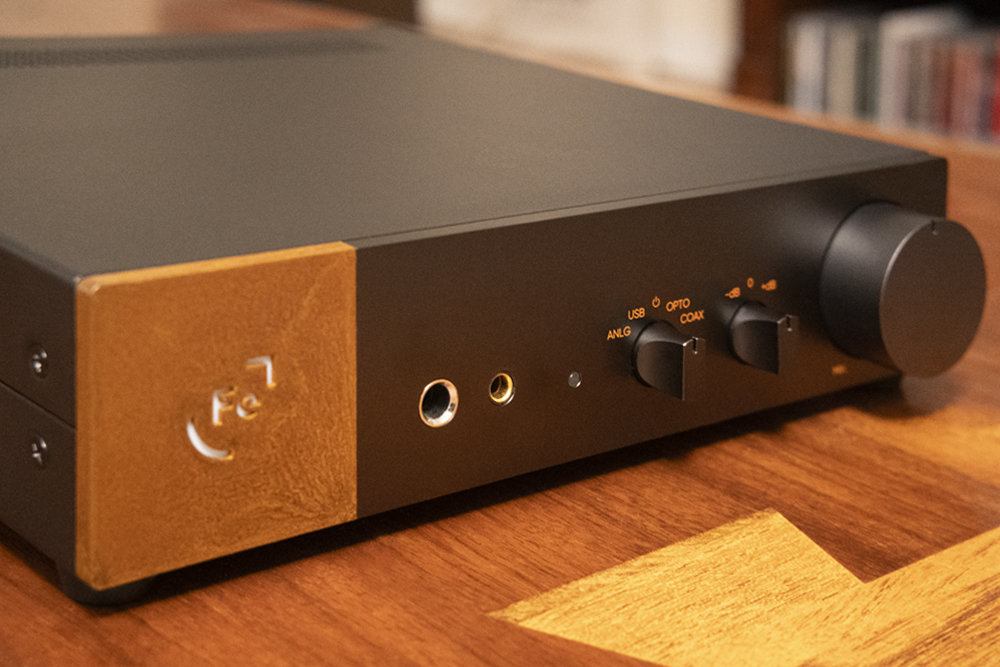
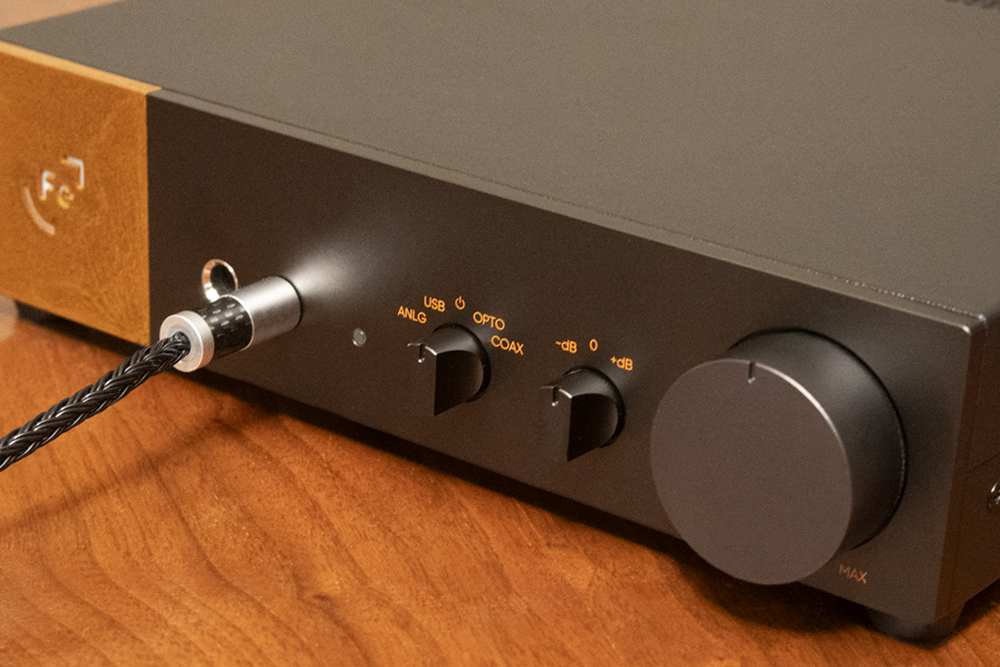
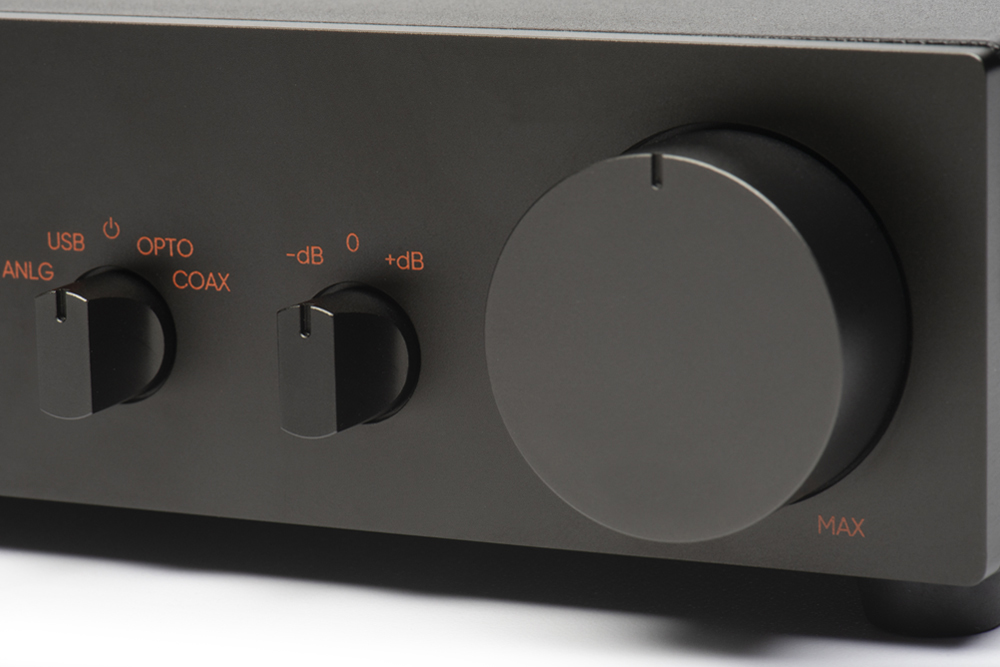
Like the Hypsos, Oor, and Wandla, the Erco Gen 2 has a chassis that measures 2″H × 8.6″W × 8.1″D, feet, knobs, and connectors not included. And the visual language across the Erco’s front plate is much the same as with those other Ferrum products. On the left is Ferrum’s signature rust-colored metal slab with an illuminated logo in its center; on the right is the large volume knob. A ¼″ single-ended headphone jack, a 4.4mm Pentaconn balanced jack, a colored LED indicator light, and two small rotary switches—one to control power and source selection, and the other to select from three gain settings—complete the fascia of the Erco Gen 2.
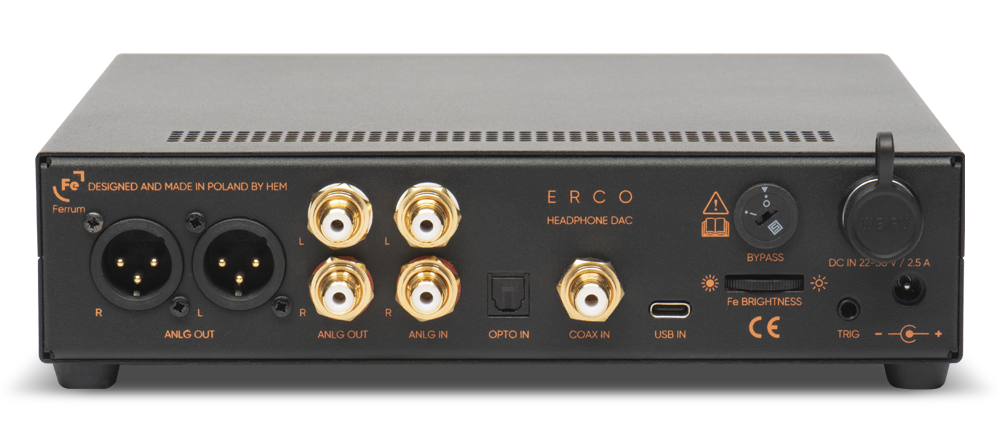
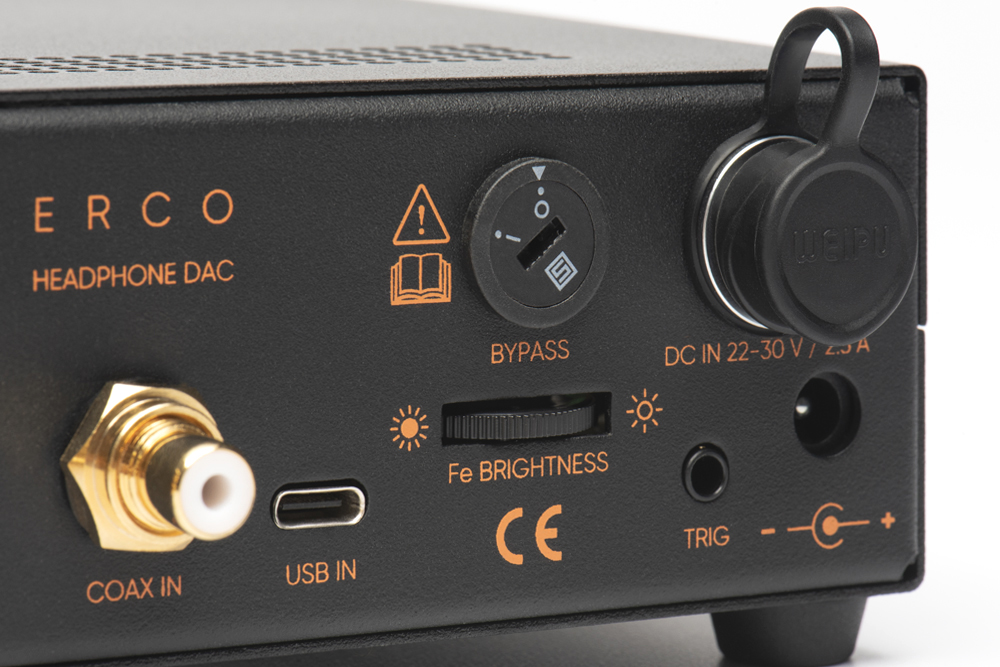
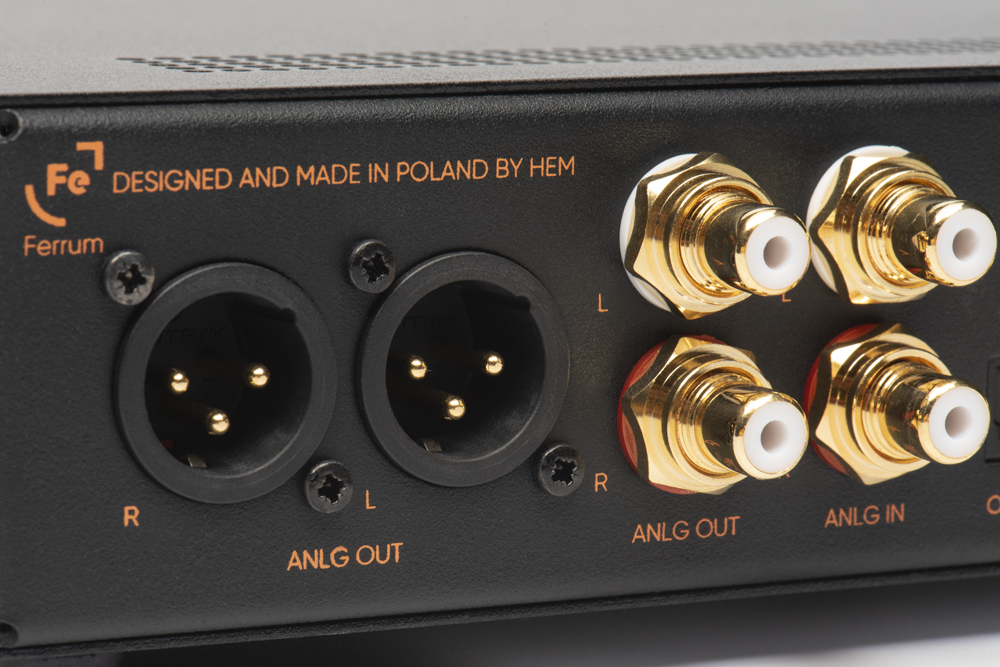
Across the Erco Gen 2’s back panel, from left to right, are pairs of balanced and single-ended line-level output jacks (XLR and RCA, respectively); a pair of RCA analog inputs; and optical S/PDIF (TosLink), coaxial S/PDIF (RCA), and USB‑C digital inputs. There is a volume-control bypass switch, which is cleverly designed to be impossible to actuate accidentally. A small scroll wheel allows adjustments to the brightness of the illuminated “Fe” logo. A 3.5mm jack allows the Erco Gen 2 to trigger another device via a 12V signal, and there are two power-input connectors: a standard DC jack that will accept 24V from the included switching supply, and a four-pin socket that accepts supply voltages ranging between 22 and 30V from a Hypsos unit via a Ferrum Power Link cable.
Getting techy
Under the hood, the Erco Gen 2 uses Ferrum’s ARM-based Serce board to orchestrate everything. It manages incoming PCM and DSD signals, decodes and renders MQA signals, and handles digital filtering, along with performing auxiliary functions like operating the various relays for signal switching between inputs and so on. Hence, the Erco Gen 2 can handle PCM resolutions up to 768kHz and up to DSD512, and the analog input can take professional input levels as well as the consumer-standard 2V level. The original Erco only handled up to 384kHz for PCM and DSD256, and could only take consumer-level analog signals, so the Gen 2 update improves functionality across all inputs. The LED on the front face will change color depending on the input-signal type; I used only PCM for the duration of my testing, so I only ever saw the LED light up orange.
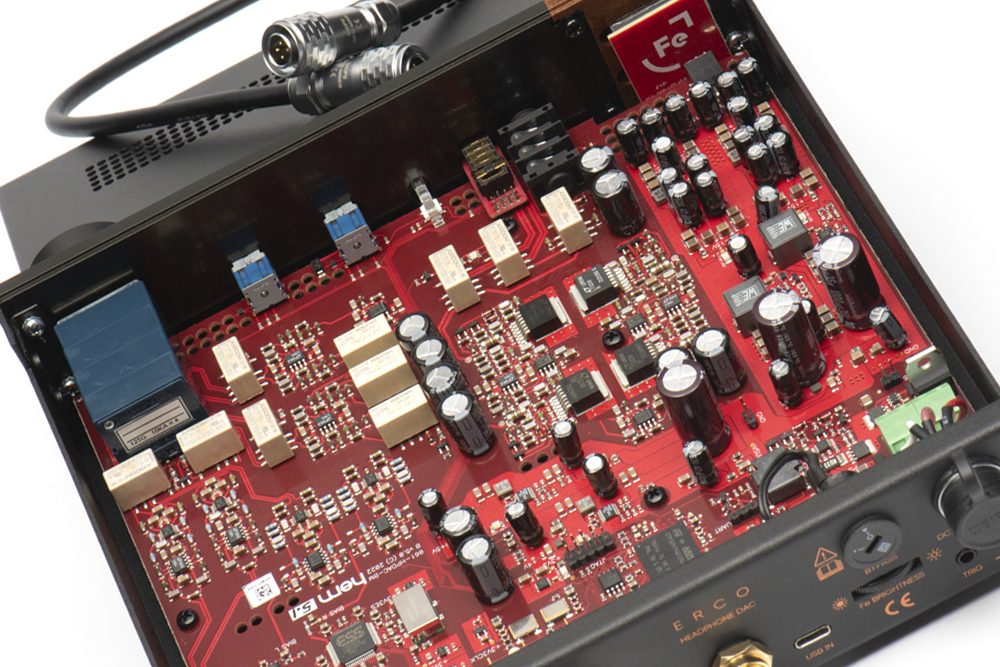
Digital conversion is done by an ESS Sabre ES9028PRO chip. The Erco Gen 2’s I/V amp section has been upgraded from the original Erco’s with lessons learned from the Wandla—it’s not the same compound amplifier topology as the flagship DAC’s, but it’s in the same “club,” according to Ferrum CEO Marcin Hamerla. The Erco Gen 2 uses Ferrum’s HD Apodizing digital filter, which Ferrum found was the most popular filter based on customer feedback from the Wandla. Unlike the Wandla, however, the Erco Gen 2 doesn’t provide the ability to swap between digital filters.
Finally, there is the balanced output via four LT1210 amplifiers, chips that are typically used to drive high-speed internet or video data down long cables. Their use for audio was strange, so I asked why the Erco Gen 2 uses them instead of audio-grade devices. According to lead analog designer Maks Matuszak, Ferrum chose this implementation because it offers much of the benefit of the Oor’s discrete topology without the complexity or high parts count.
Ready to get nerdy? Gain-bandwidth product (or GBP) is a jargony term that expresses the relationship between an amplifier’s gain and its bandwidth. If you look at a typical GBP chart showing gain versus frequency, you’ll see a curve that looks a bit like Mount Fuji—a mountain with two straight slopes leading up to a flat top. This means that as the gain is lowered via negative feedback, the bandwidth of the amplifier goes up. The perhaps less-intuitive upshot is that as more negative feedback is used, the amount of gain the feedback network can use to correct distortion at higher frequencies diminishes. GBP has, in the past, been regarded as unimportant for audio, since just about any sensible amount of feedback is enough to get an amplifier to reproduce the whole audioband.
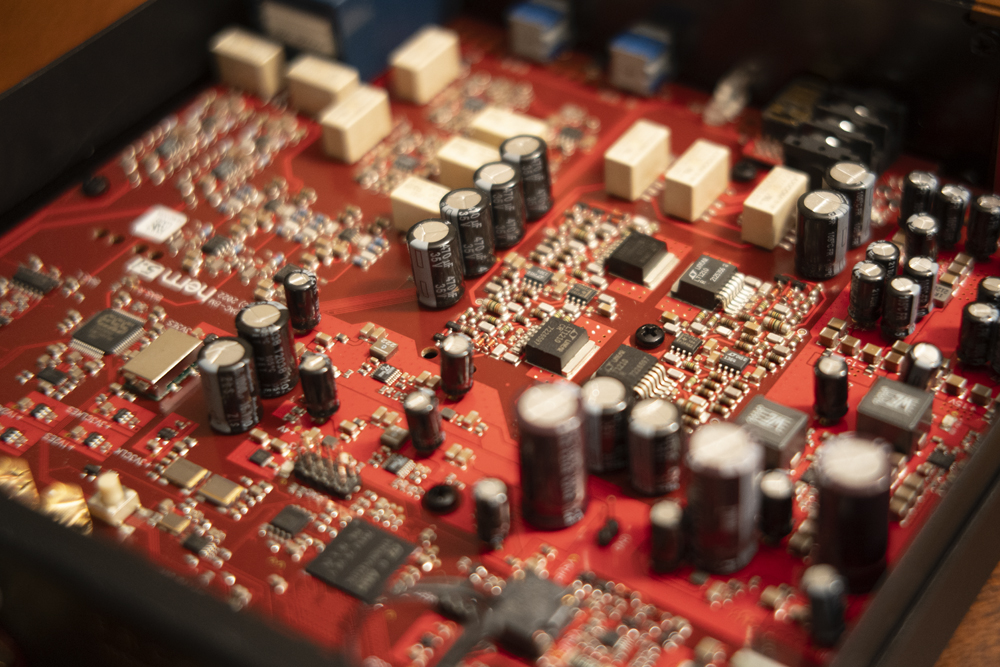
According to Matuszak, the LT1210’s high GBP is a side effect of the real reason it was chosen—that flat part at the top of the GBP graph. The chip has a bandwidth of nearly 20kHz with no feedback applied at all, whereas “most transistor amplifiers have an open-loop bandwidth of around 100Hz.” This means that the amount of gain available to the feedback network remains high at higher frequencies, and distortion is corrected evenly across the audioband in the Erco Gen 2. “We wanted to avoid the effect that occurs in many transistor amplifiers, where the bass is very well controlled, but the high frequencies become metallic because there is much more distortion there.”
Ferrum’s unique choice of silicon and the engineering around it resulted in a distortion claim of 0.00018% into 16 ohms at 1mW from the balanced headphone jack, a figure that is unchanged at a power level of 100mW with the same load. Via the unbalanced headphone jack, Ferrum claims 0.00032% and 0.00057%, respectively, at 1mW and 100mW power levels into a 16-ohm load. The other specs are just as good, with Ferrum claiming bandwidth that’s flat from 10Hz up to 200kHz, power output of up to 6.1W from the balanced output (rated for a 50-ohm load), digital dynamic range of 117dB, and analog dynamic range of 129dB (both A-weighted).
My setup
For my listening tests, I used Meze Audio 105 Silva (US$499, CA$699, £469, €499), Sony MDR‑1AM2 (discontinued; US$299 when available), Beyerdynamic DT 990 Pro (US$199.99, CA$259.99, £139, €149), and Massdrop × Sennheiser HD 6XX (US$199) headphones. For most of my testing, I stuck with the Massdrop × Sennheisers. They’re the most tonally accurate pair of headphones at my disposal, which helps with sniffing out any changes to the sonic presentation. Full disclosure: I did give the Erco Gen 2 a try with a Hypsos power supply, but during all critical listening, I used the stock laptop-style unit.
I used my Oppo BDP‑105 Blu‑ray player (discontinued; US$1199 when available) as both a digital transport and a source of comparison. A Tributaries Delta coaxial S/PDIF cable ferried digital data to the Erco Gen 2. The headphone-based setup was used for most of my time with the device, but I also used this combo in my two-channel system, with the Erco Gen 2 serving as a DAC‑preamp. The speakers were a pair of Paul Carmody–designed Amigas built from a Parts Express kit; they were footed by a set of IsoAcoustics Gaia III Neo feet and driven by a First Watt F5 power amplifier. My LG C1 OLED smart TV served as a secondary source for streaming via Spotify. A pair of Have Inc. RCA cables and AmazonBasics 14-gauge OFC cables transmitted low- and high-level signals, respectively, and a Monster TosLink cable linked the TV to the Erco Gen 2.
High bandwidth, high expectations
I wasn’t sure quite what to expect with the Erco Gen 2. Would it carry the same sonic signature as Ferrum’s flagship DAC? Or would the fact that it was directly driving a pair of headphones via its unique headphone-output circuitry give it a totally different sonic texture? What if it sounded light-years away from what I’d heard with the Wandla? I plugged my Sennheiser HD 6XX headphones (equivalent to the HD 650s in every way except aesthetics) into the Erco Gen 2 with a Pentaconn-terminated cable.
I popped an old favorite of mine into the Oppo: Smashing Pumpkins’ Siamese Dream (CD, Virgin 0777 7 88267 2 9). This is a dense, heavy record, filled with fuzzy guitar washes and thudding bass—frontman Billy Corgan and producer Butch Vig both have attested that dozens of guitar overdubs were layered on each track to achieve the album’s crushing, gigantic sound. Picking out every last detail on this record is a challenge for even the most capable headphones, and good amplification is a must.
The Erco Gen 2 met the recording’s demands, though, and on the fuzzy, grungy track “Hummer,” I was able to hear the subtle chorus effect on the bass guitar underpinning the track—indicating that the Erco Gen 2 maintained superb control of the HD 6XXs’ low end. Even through the song’s noisy chorus sections, Corgan’s voice and the acoustic space around it were extracted with precision. Vocal clarity and dynamics were good, despite the layers of guitars and dynamic-range compression (the CD release of Siamese Dream scores a decent-but-not-great DR10 on the Dynamic Range DB database).
Was this the Erco Gen 2’s LT1210 output stage in action? With a triple-zero distortion spec, it’s hard to say for certain, but it’s easy to imagine that the Ferrum’s command of the HD 6XX headphones’ drivers was due largely to its design. On “Mayonaise” from the same album, I noticed that the leading edges of guitar plucks and strums and of snare and cymbal hits sounded neither blunted nor over-hyped. The clean, controlled sonics through the high frequencies initially impressed me as a laid-back overall sound. But deeper listening revealed it was more than that.
The Erco Gen 2 is actually very dynamic and quick on its feet, though its tight grip on the midrange and treble can cause one to mistake its neutrality for languor. I struggled to this conclusion while listening to Natalie Merchant’s Tigerlily (CD, Mobile Fidelity Sound Lab UDCD 771). On “The Letter,” a track featuring only vocals and piano, my first impression was that the Erco Gen 2 sounded a bit dark on the piano introduction. But when Merchant’s voice entered, it came through with an uncommon sense of immediacy. This is partly due to the excellent recording, but part of what I heard was certainly due to the Erco Gen 2’s steely grip on the HD 6XX headphones. I heard a voice suspended in a credible-sounding acoustic space, and the simple piano accompaniment was thick with tonal density.
I listened right through to the following track, “Cowboy Romance.” Again, I noticed that density, detail, and immediacy were strong points. The fiddle and guitar sounded especially clear, with accurate timbres, even as the intensity of Merchant’s singing and piano built around them.
I switched to XTC’s 1992 album Nonsuch (CD, Geffen Records GEFD‑24474). This Bob Ludwig–mastered rock album isn’t as intimate as Tigerlily, nor does it have the thickness or density of Siamese Dream. A great sense of space and separation between sonic elements is on display here—as well as gobs of bass. On “The Smartest Monkeys,” I heard visceral bass and clarity and accuracy in the vocals. The Erco Gen 2 seemed to tease out the last bit of space and soundstage from the HD 6XXs. Despite their open-back design, the Senns are not soundstage champs—they sound almost like closed-back headphones in that regard. The Erco Gen 2 couldn’t make them do things that they just can’t do, but the little Ferrum brought the best out of them.
This impression was reinforced on “Rook,” an intentionally spare song anchored by big piano chords and featuring horns and strings but no percussion (save a couple tambourine shakes). I felt that the Erco Gen 2 and the Sennheisers dredged up clues about the careful recording and mixing decisions made by the band and the audio engineers on this track. The hugeness of the piano block chords and the lingering, cavernous reverb tails on frontman Andy Partridge’s vocals seemed to create an awfully deliberate atmosphere for the song, and the Erco Gen 2 represented these easily lost elements in all their haunting glory. It’s subtle details like these that decide the mood of a song, and they’re among the things I listen for when evaluating a component. The Erco Gen 2’s seemingly effortless ability to draw them out on this recording allowed me to sink into the music—exactly what a superlative component ought to do.
In sum, the sonic signature of the Erco Gen 2 was almost exactly what I’d expected, in all the best ways. Like the Wandla, its presentation was smooth and musical, but without any loss of nuance or detail. Soundstage depth and precise imaging were strengths, but there was no crossfeed or second-harmonic distortion trickery happening here. The Erco Gen 2 has earned that glowing “Fe” logo, to my ears.
Au compare
Because I was spinning these discs with my Oppo BDP‑105 Blu-ray player, no rearranging of gear was required for the task of comparison. The BDP‑105, like the Erco Gen 2, has an ESS Sabre–based digital-conversion section, and it’s also got a chip-based headphone amp—albeit a totally different design than Ferrum’s. The Oppo only has a ¼″ single-ended jack, so I used my HD 6XX headphones with their standard, unbalanced cable.
The BDP‑105 had little trouble driving the Sennheisers, but the sound was nonetheless markedly less controlled at the frequency extremes, and the sense of separation the Erco Gen 2 provided gave way to a blurrier sonic picture through the Oppo. This isn’t to say the Oppo’s performance was poor, just that it didn’t demonstrate the control or effortlessness the Erco Gen 2 did. Returning to Siamese Dream and playing “Hummer” again, I noticed the lows sounded mushier, and the modulation effect added to the bass guitar was impossible to discern. The mids and highs all gelled really nicely via the Oppo’s headphone output, adding to the wall of sound that is Billy Corgan’s multilayered electric guitar. But the penalty was that the vocals and percussion lost the polish and refinement they’d had through the Erco Gen 2; they seemed at once a bit harsher and a bit further back in the mix.
Though I didn’t have them side-by-side to compare, it’s worth talking about the Wandla DAC compared to the Erco Gen 2. Now up to nearly $3200 here in the US, the Wandla costs nearly 60% more than the Erco Gen 2, and if you want a headphone output, there’s a US$500 premium on top of that. I can’t comment on the Wandla HP’s headphone performance, but I can tell you how the Erco Gen 2 stacks up in a two-channel system.
In short: the performance comes very close, but convenience is sacrificed somewhat, since the Erco Gen 2 is more at home on a desktop driving a pair of ’phones than doing preamp duty. The Erco Gen 2 has no screen, and, importantly, it does not have a remote control for changing the volume or source. Based on what I heard with the Erco Gen 2 in the same two-channel setup as the Wandla, the Erco Gen 2 comes awfully close to the Wandla in terms of subjective performance, though the flagship DAC has a slight edge in terms of refinement and soundstage depth. It’s not night-and-day, and given the price differential and its excellent headphone amplifier, I think the Erco Gen 2 would be a better bargain for many audiophiles, especially those who like their headphones as much—or more—than their speakers. And I say that as someone who absolutely fell in love with the world-class Wandla.
Rah! Rah! Rah?
It’s at this point in writing a review that I invariably have a Dennis Burger moment, and the word value starts swirling around in my head. It’s hard not to think of the Erco Gen 2 in terms of the value it offers. I mean, US$2050 is not a small sum of money to spend on a piece of audio gear. But consider how the Erco Gen 2 stacks up to its pricier Ferrum brethren. The Erco Gen 2 offers functionality the Wandla lacks (namely, its kick-ass headphone amp) and functionality the Oor lacks, too (the Oor does not have digital inputs). Want a Wandla but can’t imagine spending upwards of three grand on a DAC? Erco. Want an Oor but can’t justify going that far on an amp when you’ll also need a DAC? Erco. The Erco Gen 2 is a viable alternative to the US$3695 Wandla HP or even an Wandla-and-Oor combo at US$5470. And at the level of performance the Erco Gen 2 offers, it’s difficult to argue that it’s cutting US$3420 worth of corners.
For many hi‑fi enthusiasts, the Erco Gen 2 will represent the best entry point to Ferrum’s products. In fact, I think it could be an endgame DAC-amp for a lot of headphone nuts, though it also integrates into a two-channel system very well (so long as you don’t mind standing up to change the volume). With the Gen 2 revision, Ferrum’s added a fair bit of value to the OG Erco, and it’s still upgradable by adding a Hypsos as wants or needs dictate. Ferrum, if you’re listening, I think Gen 3 should either be portable (fat chance), or become a two-channel world-beater by adding a remote. As is, it’s hard not to recommend the Erco Gen 2, because it offers so much. Am I a Ferrum cheerleader? Gimme an “F!” Gimme an “E!” Gimme an “R . . .”
. . . Matt Bonaccio
Associated Equipment
- Headphones: Massdrop × Sennheiser HD 6XX, Meze Audio 105 Silva, Sony MDR-1AM2, Beyerdynamic DT 990 Pro
- Transport: Oppo BDP-105
- Speakers: DIY Paul Carmody Amiga, built from a Parts Express kit
- Power amplifier: First Watt F5
- Turntable: Micro Seiki DQ‑3 with Micro Seiki MA-707 tonearm
- Phono cartridge: Audio‑Technica AT95 with AT‑VMN95SH Shibata stylus
- Digital cables: Tributaries Delta 75-ohm coaxial; Monster Cable optical cable
- Analog interconnects: Have Inc. RCA cables
- Speaker cables: AmazonBasics 14AWG OFC speaker cables
- Display: LG OLED55C1AUB
- Internet router: Netgear R6080; Jameco 170245 Linear Regulated DC supply
- Accessories: IsoAcoustics Gaia III Neo footers, Little Fwend tonearm lifter, Michell Audio record clamp
Ferrum Audio Erco Gen 2 DAC–headphone amplifier
Price: US$2050, CA$2890, £1795, €1795
Warranty: Three years, parts and labor
Ferrum Audio
Al. Jerozolimskie 475
05‑800 Pruszków
Poland
Phone: +48 22 823 72 38
Website: www.ferrum.audio
Email:
US distributor:
VANA, Ltd.
66 Southern Blvd., Ste C
Nesconset, NY 11767
Phone: (631) 246 4412
Website: www.vanaltd.com
Email: