
Sound: 


Value:
(Read about our ratings)
Three years and dozens of reviews ago, I reviewed the Sennheiser Momentum 4 Wireless headphones. They were good, not great, but certainly decent noise-canceling over-ears. While they weren’t my first pick in the category, I found their bright sound a welcome sparkle in a sea of often duller, more bass-heavy headphones.
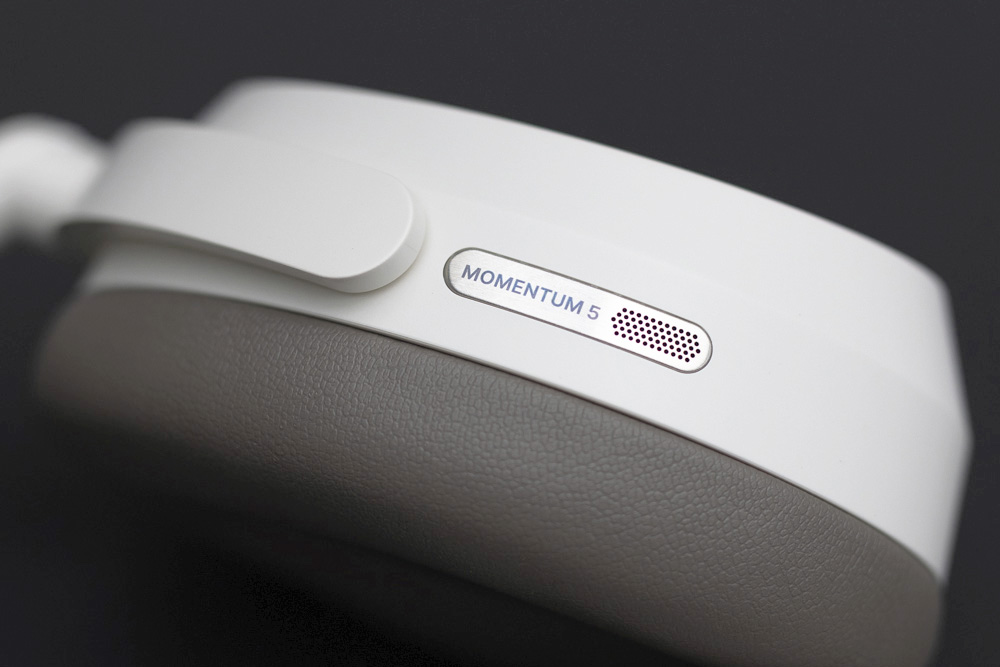
The new Momentum 5 Wireless headphones have only subtle changes on the outside, but some significant changes on the inside, including better noise canceling, a different sound profile, and, in what I hope is a new trend, a user-replaceable battery.

Priced at US$399.95, CA$569.95, £329.90, or €399.90 as of this writing in mid-June, they’re around the same price as major players from the likes of Sony, Bose, and others. In most ways, they’re a solid improvement over the Momentum 4s, though some people might not think so.
In the box
With the Momentum 5s you get a hardshell case, USB‑C‑to‑USB‑C charging cable, and a 3.5mm-to-2.5mm analog cable. The case has the same textured cloth and color as the headphones, which is a nice touch.
Use
The Momentum 5s are wonderfully light at 290g—not quite the featherweight of the Sony WH‑1000XM5 headphones, but lighter than most of the over-ears I’ve reviewed lately, including the Fender Mix headphones. That, paired with soft padding and faux leather, makes them very comfortable, though your ears can get a bit hot.

There’s only one physical button, on the lower rear of the right earcup. This turns the headphones on and off with long presses, and activates your voice assistant with a single press. All other controls are handled via the touch-sensitive right earcup. Taps, swipes, and two-finger pinches and spreads all control different aspects. You can’t change these, but the app does give you a list so you don’t need to find the manual to figure out how to change the volume (slide a finger up or down) or whatever.
Speaking of the app, it’s called Smart Control, and it’s elaborate and well-laid-out. You can fine-tune the noise canceling, create GPS-linked “sound zones” to adjust the sound to a specific place (home or office, for example), switch between connected devices, and so on. There are multiple EQ presets, or you can design your own with an eight-band manual option. There’s also a Sound Personalization feature that gives you a hearing test and tunes an EQ for you. The app has a Bass boost option, but as you’ll see, I don’t think you’ll need it.
Diving deeper into the settings, you can have the M5s prioritize sound quality over a stable wireless connection. That’s not ideal when you’re out and about, but it’s certainly worth trying at home. The app has another rare feature I always like to see: it displays what codec is used and at what sampling rate. Not crucial information, but I like checking what’s going on in the background. You’re limited, of course, to whatever your source can handle. If you want to skip Bluetooth, you can connect via analog or USB, the latter enabling much higher sampling rates and resolutions.

Like the Sony WF‑1000XM6 earphones I reviewed last month, the Momentum 5s have a Battery Protection Mode feature to extend the life of the lithium-ion battery by only slow charging and limiting the maximum charge. It’s worth turning on if you plan on having the headphones for a while and don’t mind ~20% less playtime.
Sound
The Momentum 5s have boosted bass and treble, with a bit of high-treble roll-off. The result isn’t neutral, but it is fun. I’m sure most people will enjoy the sound.

Starting with America’s “Ventura Highway” (Homecoming, 16‑bit/44.1kHz ALAC, Warner / Apple Music), I found the guitars bright and jangly, but not piercing. I’m usually not a fan of extra treble, since it often becomes hard to listen to. That wasn’t the case here—there was some extra clarity and presence, but not enough to make the sound harsh. The soundstage wasn’t particularly wide—barely wider seeming than the earcups. There is an Immersive Audio feature, but this didn’t make this stereo track any bigger. If anything, it recessed the vocals, which otherwise weren’t significantly laid back, despite the noticeably louder treble and bass.
Immersive audio gets better with Dolby Atmos, so next up was Pink Floyd’s “Money” from The Dark Side of the Moon (Dolby Atmos, Sony / Apple Music). This is probably my least-favorite Pink Floyd song thanks to how much it’s overplayed. The opening cash registers are certainly useful to test this aspect of sound, however, and through the M5s, they did indeed bounce around. Even with this feature enabled, the M5s did not have a particularly expansive sound.
Skipping forward a few tracks, “Brain Damage” did a good job showing off the M5s’ pros and cons. There was lots of bass, so it sounded like Roger Waters had a bigger stack of amps than David Gilmour. Waters’s vocals weren’t overwhelmed though. It was more like having an imaginary EQ set to Bass+2 and Treble+1. The heartbeats that accompany the transition to “Eclipse” had significant heft. I enjoy extra bass, and I thought the Momentum 5s had decent bass: a touch boomy, lacking a little definition, but fun overall. If your preferred music benefits from extra bass, these headphones will work great.

In terms of noise canceling, the M5s are really good. Not quite as incredible as the in-ears I recently tested but definitely in the same ballpark as the better over-ears. If you’re only in the market for the best noise-canceling headphones, these headphones aren’t quite that, but they’re close enough that you won’t be disappointed.
Comparison
Given that they were on hand and I liked them a lot, I compared the Momentum 5s to the Fender Mix headphones. I also compared them to the Momentum 4s, since they are still available and now a lot cheaper.
Starting with the M4s, I cued up Aimee Mann’s “Goose Snow Cone” (Mental Illness, 24/44.1 ALAC, SuperEgo / Apple Music). Through the M5s, the opening bells were bright but not overly so. Through the M4s, they were a little brighter, more crystalline. The guitar was fuller-sounding through the M5s but sounded more natural through the M4s. Because the M4s have less bass, their treble seemed more pronounced. That said, they definitely had more upper treble and airiness than the M5s. My preference was for the M5s, but if you like treble, you’ll probably prefer the M4s.
Switching to the Fenders, I put on the bass-heavy (to put it mildly) “Escape Velocity” by the Chemical Brothers (Further, 16/44.1 ALAC, Virgin / Apple Music). When the bass drops in this track, the Fenders delivered plenty of low end. But the M5s’ bass went deeper, and there was more of it. It was a little less controlled, with a little more boom than punch, but never sloppy. I’m not sure the M5s are worth $100 more than the Mixes, but I do like them better.
Conclusion
If you’ve read any of my other reviews, it will probably come as no surprise that I like the Momentum 5 Wireless headphones a lot, certainly more than the M4s. I’ll also be the first to point out that these headphones are not for people who dislike bass. The additional treble gives them a nice sparkle, so they don’t sound dull, but together that means these are not neutral-sounding. That doesn’t bother me, but I know neutrality is something many readers are looking for.
So basically, I’ll call the Momentum 5s an improvement over the M4s, especially if you like bass. If treble is more your thing, and you don’t mind worse noise canceling, the M4s are more neutral and have the benefit of being cheaper.
. . . Geoffrey Morrison
Associated Equipment
- Smartphone: Google Pixel 9 Pro
- PC: iBuyPower Windows 11
- Headphones: Sennheiser Momentum 4, Fender Mix
Sennheiser Momentum 5 Wireless headphones
Price: US$399.95, CA$569.95, £329.90, €399.90
Warranty: One year
Sennheiser Electronic Corporation
1 Enterprise Drive
Old Lyme, CT 06371
Phone: 1-800-736-6434
Website: www.sennheiser.com